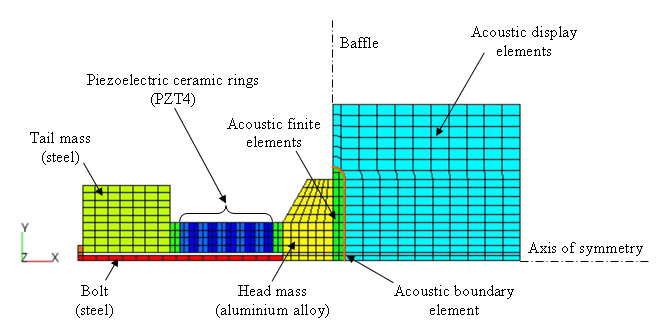
In this type of transducer, a piston is connected to a much heavier tail mass by some axially polarised ceramic rings, and with a connecting bolt running through the middle. An alternating voltage applied across the electrodes causes axial extension. The vibrating piston displaces the fluid causing energy to be radiated through the acoustic medium. At low frequencies the piston generally behaves in an “ideal rigid” manner. At higher frequencies “head flap” may occur. This is less efficient for radiating sound. The example below is axisymmetric, and radiates into a half space. It is sufficient to model the generator plane.
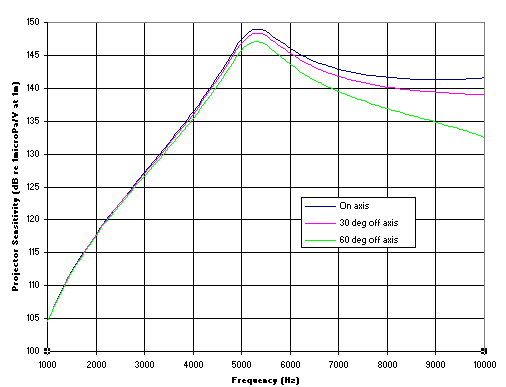
Projector sensitivity against frequency
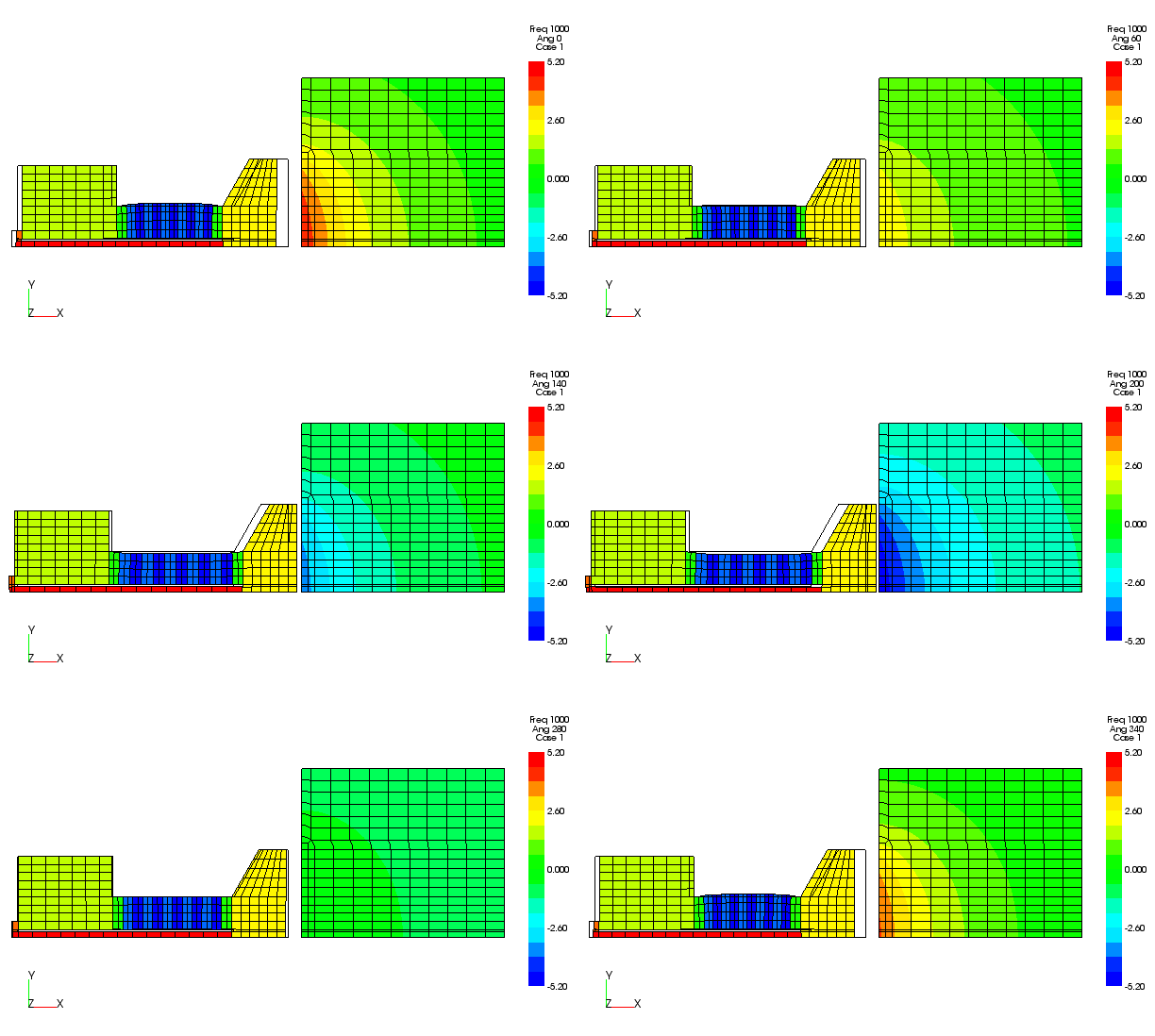
Animation of structural deformation and pressures at 10000Hz.
In the above two diagrams the structural and acoustic mesh parts have been slightly separated from each other to allow the deformed shape of the structure to be seen. The boundary of the undeformed structure has been superimposed.
At the lower frequency the piston behaves in an “ideal rigid” manner. At the higher frequency “head flap” can be seen to occur, which is less efficient for radiating sound.
Various other quantities may be graphed such as admittance, impedance, conductance, susceptance, resistance reactance and directivity. Some sample graphs are shown below:
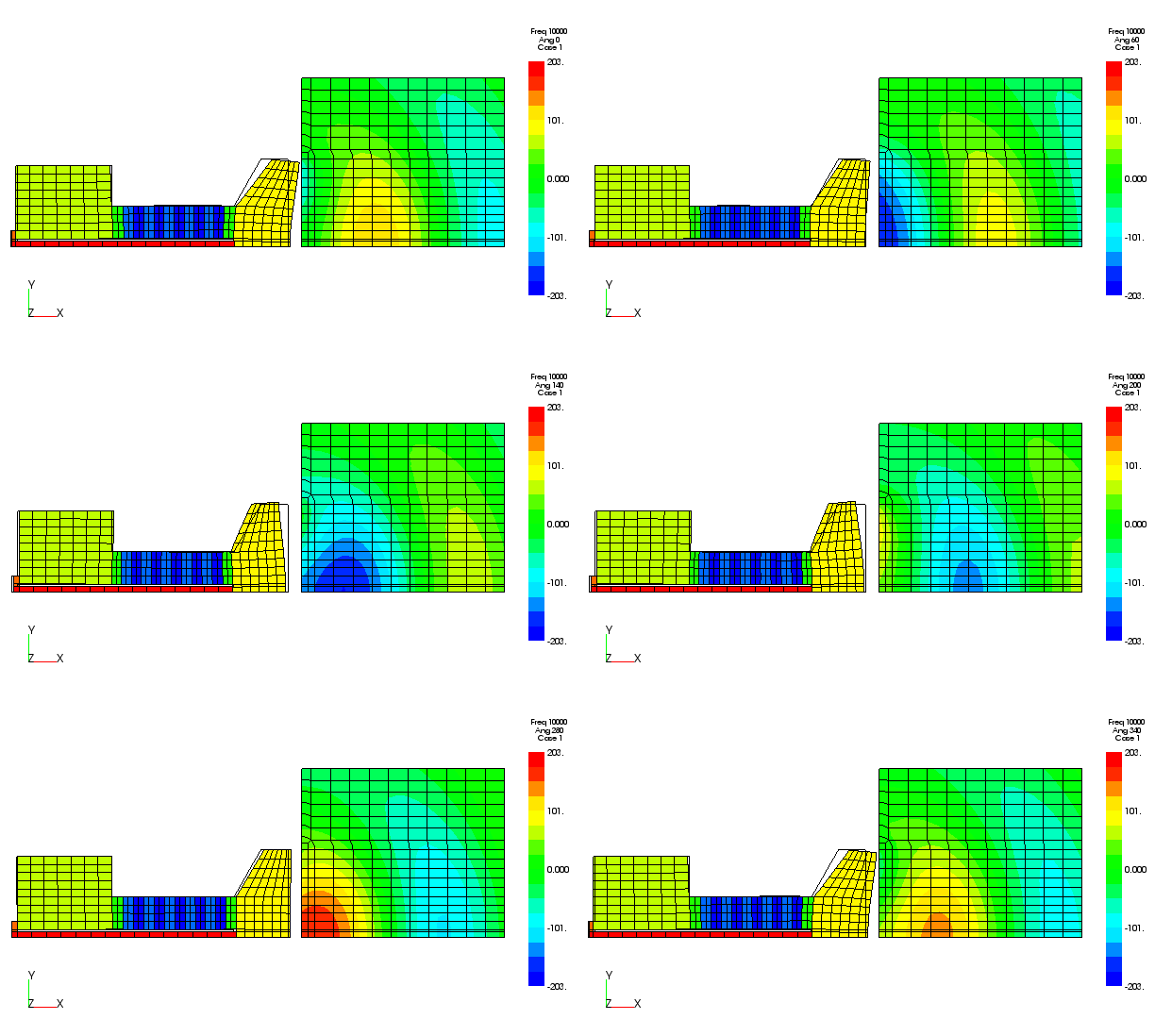
Animation of structural deformation and pressures at 10000Hz.
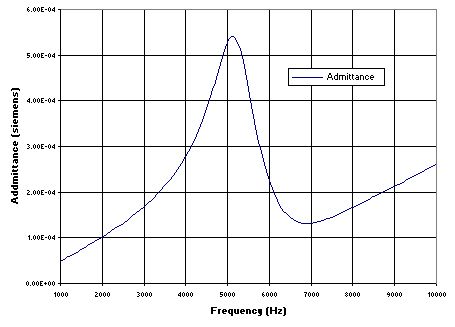 Admittance v Frequency. |
 Impedance v Frequency. |

Directivity at 10000Hz.